
Ireland’s World Cup Heartbreak: A Neutral Fan’s Guide to 2026
 Available in US
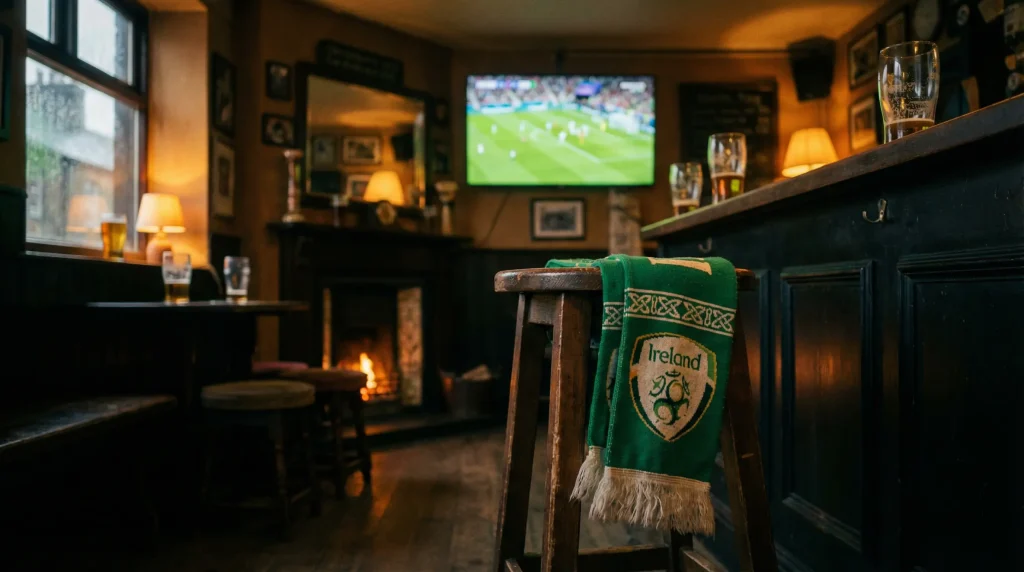
I was in a pub in Dublin on 26 March 2026 when Tomáš Souček stepped up to take Czechia’s fourth penalty. The place was heaving. Somebody behind me was gripping my shoulder so hard I could feel individual fingers. When the ball hit the net and the final score read 3-4 on penalties, the noise did not stop — it just changed. From roaring to silence to a low, collective exhale that sounded like an entire nation deflating. Ireland had drawn 2-2 in normal time, played their hearts out, and lost the World Cup playoff on spot kicks. Again. We are professionals at this particular kind of suffering.
That penalty shootout ended Ireland’s 2026 World Cup dream, but it did not end the World Cup. The tournament starts on 11 June, it will be the biggest in history with 48 teams across three countries, and every pub in Ireland will have it on. The question is not whether we will watch — of course we will watch. The question is who we adopt, what we look for, and how we turn six weeks of someone else’s tournament into something that still feels like ours. I have spent the weeks since that Czechia match working through my own version of the five stages of grief, and I have arrived at acceptance. Here is my guide for every Irish fan who needs a plan.
How We Got Here: The Qualifying Campaign
The anger has not fully subsided, so let me channel it productively. Ireland’s UEFA qualifying campaign for the 2026 World Cup was a story of competence undermined by fine margins. We were drawn in Group F alongside Portugal, Denmark, Greece, Armenia, and Andorra. Nobody expected us to top the group — Portugal were always going to qualify directly, and they did, winning nine of ten matches. The battle was for second place, the playoff spot, and Ireland fought for it with a determination that deserved better than its eventual outcome.
The numbers tell a story of a team that did almost enough. Ireland finished second in the group with 19 points from 10 matches — five wins, four draws, one defeat. The sole loss came away to Portugal in Lisbon, a match we were competitive in until the 78th minute. The draws were the killer: 1-1 at home to Denmark, 0-0 away to Greece, 1-1 away to Denmark, and 0-0 at home to Greece. Those four draws represented eight points dropped against beatable opponents, and any one of them converting to a win would have given Ireland a more comfortable path to the playoffs. The frustration was not that Ireland were bad — they were not. It was that they were not quite ruthless enough, particularly against Greek sides that came to Dublin and sat deep with discipline Ireland could not break down.
The playoff semi-final against Czechia was the cruelest possible ending. Ireland took the lead through a superb Evan Ferguson header from a Robbie Brady cross, conceded an equaliser before half-time, retook the lead through a Chiedozie Ogbene strike, and then conceded again in the 88th minute from a set piece that should have been defended. Extra time produced no goals. The penalty shootout was agony — Ireland missed their third and fifth kicks, and Czechia converted four of five to advance. The empty feeling in that Dublin pub was not just about one match. It was about another World Cup cycle, another near miss, another tournament we will watch from the sofa instead of the stands.
But grief has a shelf life, and mine expired about two weeks after the Czechia match. The 2026 World Cup is going to be extraordinary — the first 48-team edition, spread across Mexico, the USA, and Canada, featuring teams from every corner of the football world. Ireland will not be there, but we have adopted teams before, and we will do it again. The question is which ones.
Who Should Irish Fans Support? My Picks
Let me start with the obvious one: Scotland. If you are an Irish football fan and you do not feel at least a flicker of warmth toward Scotland at this World Cup, I question your Celtic credentials. Scotland have not been at a World Cup since France 1998, when they were eliminated in the group stage after a Craig Burley red card against Morocco. Twenty-eight years of waiting. Twenty-eight years of the same tournament heartbreak we know so intimately, except Scotland’s heartbreak lasted longer and cut deeper because they kept missing out through qualification failures rather than playoff drama.
Scotland are in Group C alongside Brazil, Morocco, and Haiti. It is a brutal draw — Brazil are genuine title contenders, and Morocco reached the semi-finals in 2022. But Scotland under Steve Clarke have become exactly the kind of structured, defensively disciplined side that can grind out results in group stage football. They qualified by finishing second in their UEFA group and winning their playoff, and the squad contains Premier League regulars like John McGinn, Scott McTominay, Andrew Robertson, and Billy Gilmour. Scotland will not win the World Cup. They might not get out of the group. But the scenes in pubs across Dublin and Glasgow if they beat Haiti in their opener and then hold on for a draw against Brazil would be worth the emotional investment alone. I will be wearing green on the inside and tartan on the outside for every Scotland match.
My second pick is more complicated: England. I know. I can already hear the objections. But hear me out. Every Irish football fan has a relationship with English football through the Premier League. We watch their league every weekend. We know their players. We have opinions — strong ones — on their tactical setup, their squad selection, their manager’s substitution patterns. Supporting England at a World Cup is not about national loyalty. It is about familiarity. When Declan Rice (born in London, raised in Kingston, declared for England after three Ireland friendlies) plays in the group stage, every Irish fan will have feelings. Those feelings are a form of engagement, and engagement is what makes a tournament worth watching as a neutral.
England are in Group L with Croatia, Ghana, and Panama. They should qualify comfortably, and their squad is loaded with Premier League talent that Irish fans watch every week. The narrative tension — can this generation finally win a major tournament? — is compelling regardless of your national allegiance. I will not be cheering for England. But I will be watching every match, and that is the point.
My third pick is a wildcard: Morocco. Their 2022 World Cup run was the best story in football that year — an African team reaching the semi-finals for the first time, beating Belgium, Spain, and Portugal along the way. Morocco are back in 2026, in Group C with Brazil and Scotland, and their squad has only improved since Qatar. For Irish fans who want to adopt a genuine underdog with a realistic chance of causing chaos, Morocco are the play. Their style of football — organised, passionate, tactically sharp on the counter — mirrors the best version of what Ireland aspire to be. Watching Morocco succeed feels like watching a version of us that made it.
The Premier League Connections
One of the underrated joys of watching a World Cup as a neutral is tracking the Premier League players scattered across different national teams. Ireland may not be at the tournament, but Irish football culture is built on the Premier League, and there are threads connecting us to dozens of teams in the 2026 World Cup.
The most obvious connection is the Liverpool contingent. Mohamed Salah leads Egypt (not qualified, but worth noting the absence), while Trent Alexander-Arnold represents England. Virgil van Dijk captains the Netherlands. Cody Gakpo, Diogo Jota, Luis Díaz — all players Irish fans know intimately from weekend viewing, all representing different nations. The same pattern applies to every major Premier League club: Manchester City’s squad is distributed across England, Portugal, Norway, Belgium, and Brazil. Arsenal’s players represent England, Japan, Italy, and Norway. These connections give Irish fans a natural entry point into matches that might otherwise feel irrelevant.
My personal tracker for the 2026 World Cup follows three specific Premier League storylines. First, the Declan Rice storyline — can the man who played for Ireland U21s win a World Cup with England? Second, the Mohamed Salah question — if Egypt had qualified, he would have been a centrepiece of the tournament. His absence is a storyline in itself. Third, the Scott McTominay narrative — a Manchester United midfielder carrying Scotland’s hopes in a group with Brazil. If McTominay scores against Brazil at MetLife Stadium, the noise in Temple Bar will rival anything the Tartan Army produces in the stadium.
For punters, the Premier League connections also create betting angles. You know these players. You have watched them week in, week out. That familiarity gives you an informational edge over bettors from other countries who are relying on international form alone. When a player proposition market opens on Scott McTominay’s shots per game or John McGinn’s tackles per 90 minutes, you have 38 Premier League matches of data to inform your position. That is a real edge, and it is one that Irish-based punters should exploit.
Late-Night Viewing Guide: IST Survival Tips
Here is the part nobody is talking about: the 2026 World Cup is going to wreck your sleep. The tournament is in North America, and the time zone difference between Ireland and the eastern seaboard of the USA is five hours during Irish Summer Time. That means an evening kick-off at 21:00 ET in New York translates to 02:00 IST. A late-night match in Los Angeles at 22:00 PT is 06:00 IST the following morning. Some matches in the western venues — Seattle, San Francisco, Los Angeles — will finish after dawn in Ireland.
I have a plan, and I am sharing it because every Irish fan will need one. For group stage matches, prioritise the ones that kick off at 12:00 or 15:00 ET. Those are 17:00 and 20:00 IST respectively — perfectly civilised viewing times that fit around work and dinner. Most group stage matches will have afternoon kick-offs, and the blockbuster fixtures (Brazil, Argentina, France, England) are likely to be scheduled for prime-time viewing in the Americas, which puts them in the 23:00 to 02:00 IST window. For those late matches, I recommend the pub over the sofa. Watching a Brazil vs Scotland match alone at 1am is misery. Watching it in a packed bar with fifty other neutrals is an event.
Scotland’s Group C schedule is particularly relevant for Irish viewers. Their opening match against Haiti in Foxborough is scheduled for 21:00 ET, which is 02:00 IST on 14 June. Scotland vs Brazil at MetLife Stadium kicks off at 18:00 ET — that is 23:00 IST, entirely doable for a Thursday night. Scotland vs Morocco in Atlanta is in the evening slot — the exact time is to be confirmed, but assume a 20:00-21:00 IST window. Two of three Scotland matches are watchable without destroying your sleep cycle. The third requires commitment, caffeine, and ideally company.
The knockout rounds shift toward later kick-offs as the tournament progresses, and the semi-finals and final are evening affairs in North American time. The final at MetLife Stadium on 19 July kicks off at 15:00 ET, which is 20:00 IST — a civilised Sunday evening. If Scotland somehow reach the final (a man can dream), that 20:00 kick-off will be the most-watched television event in Ireland since the 2002 World Cup. Plan accordingly.
Betting as a Neutral: My Approach
Being a neutral at a World Cup is underrated. You lose the emotional extremes — the ecstasy of your own team scoring, the despair of your own team conceding — but you gain clarity. Clarity is the most valuable commodity in betting. When your heart is not racing because your country’s qualification depends on the next set piece, you can analyse a match with the cold detachment that profitable betting requires. Ireland’s absence from the 2026 World Cup is a personal disappointment and a professional advantage.
My approach to betting as a neutral starts with a simple rule: I do not adopt a team for betting purposes. I cheer for Scotland. I watch England. I enjoy Morocco. But when I open my betting account, I am agnostic. Every match is a data exercise, every market is a probability assessment, and every stake is sized by edge, not emotion. The moment you start “supporting” a team through your bets — backing them when the odds are wrong because you want them to win — you have crossed the line from punting to gambling. They are not the same thing.
That said, being a neutral does create specific betting opportunities. I can bet against England without feeling guilty. I can back Brazil to demolish Scotland without it ruining my evening. I can take Czechia — the team that knocked us out — to fail in the group stage as a cold, clinical value play rather than an act of revenge (though the revenge element is a pleasant bonus). Neutrality removes the bias that costs most punters money at major tournaments. It is the one silver lining of not qualifying, and I intend to exploit it fully.
My bankroll for the 2026 World Cup is pre-allocated: 40% to group stage markets, 30% to outright and each-way positions, 20% to knockout match betting, and 10% to fun accas and player props. That allocation is identical to the one I used at the 2022 World Cup, where I finished the tournament 22% up on my starting bankroll. The group stage is where I make most of my profit because I can analyse 48 group matches with equal dispassion, finding edges that fans of participating nations cannot see through the fog of their own emotional investment. For Irish fans who want to put the heartbreak to productive use, start with the Scotland betting guide and work outward from there.
